
Ewilan's Quest, coming soon to streaming platforms!
Aimed at children aged 7 and up, the series is adapted from Book 1 of Pierre Bottero’s best-selling trilogy, with over 2 million copies sold.
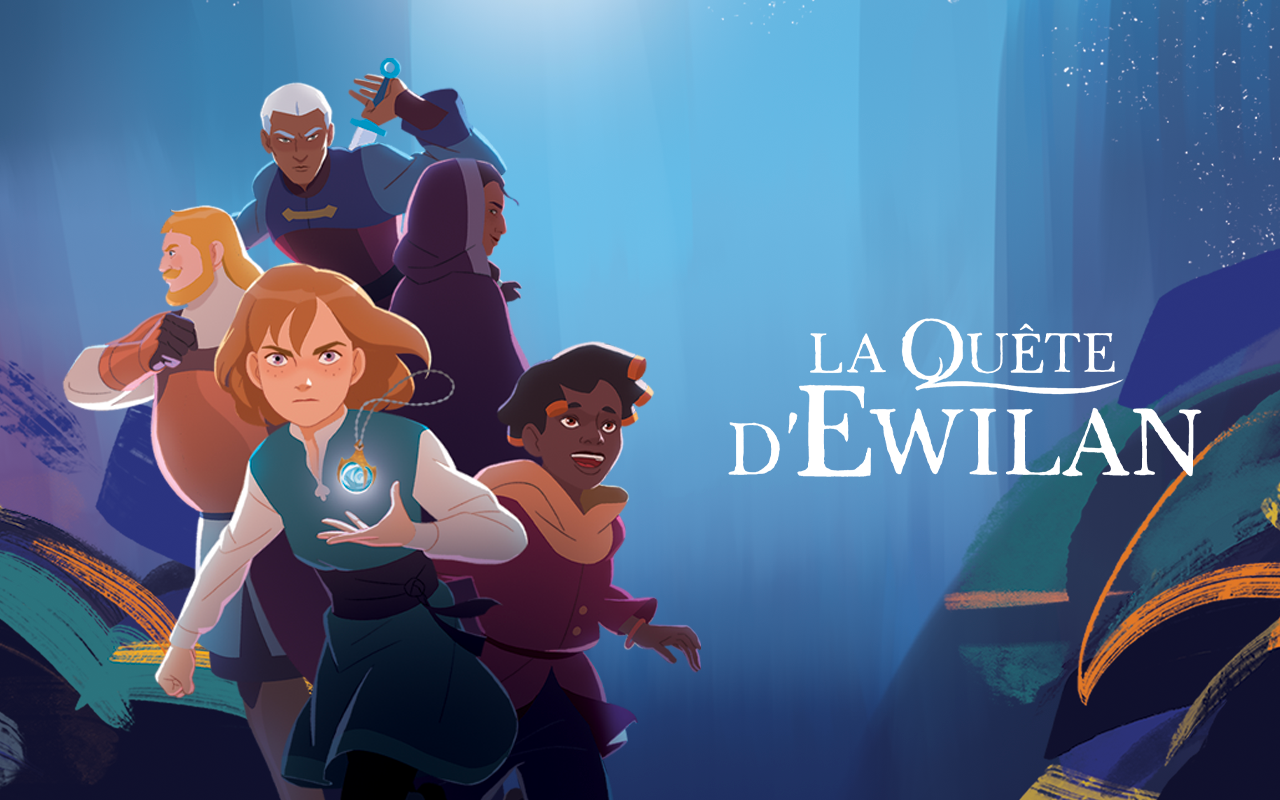
Adapted from Book 1 of Pierre Bottero’s best-selling trilogy (published by Rageot), with over 2 million copies sold, then adapted into graphic novels (published by Glénat) and audiobooks (published by Audiolib), Ewilan's Quest, the definitive fantasy novel for pre-teens, is now an original animated series produced by the French company Andarta Pictures in co-production with Vivi Film and l’Incroyable Studio. The series launches simultaneously on 3 European French-language broadcasters: France Télévisions (France 4 / France.tv / Okoo) for France, RTS (Play RTS) in Switzerland, and RTBF (Auvio) in Belgium from February 14.
Ewilan's Quest follows in the tradition of epic heroic-medieval fantasy narratives, like J.R.R. Tolkien’s Lord of the Rings trilogy or C.S. Lewis’s beloved Chronicles of Narnia. This literary genre transcends generations and continues to thrive through audiovisual adaptations that consistently captivate audiences.
In a universe steeped in magic and mystery, the audience grows alongside the heroes. Blending epic and intimate storytelling, the series explores universal themes such as the quest for identity, the responsibility of power, and the coming of age.
Directorial intent
Eve Ceccarelli-Moing, Fabien Daphy and Justine Mettler
Pierre Bottero’s work required bold creative choices for its audiovisual adaptation. His books, by nature, rely heavily on the reader’s imagination and mental projection, despite the precise descriptions of locations, characters, and numerous creatures.
We therefore began with an initial graphic adaptation process (landscapes, costumes, colors, fauna and flora) to envision the world of Gwendalavir, where our characters would evolve.
Our wish is to respect the original work while giving it a distinctly audiovisual dimension. In terms of themes and substance, we also wanted to push the characters’ motivations even further, making them more realistic, more complex, and sometimes ambiguous in their motivations.
With screenwriters Pierre-Gilles Stehr and Xavier Vairé, we sometimes updated the book’s themes and gave more space to female characters, in order to extend the richness of the narrative and the themes developed by the author.
Graphic choices
The graphic style is semi-realistic: clear and recognizable silhouettes, characters rendered in color blocks enhanced by advanced compositing. Particular attention is given to how characters are integrated into the backgrounds. The rendering is close to painting, with no sketched lines in the backgrounds.
As for the Spires of Imagination, the place where Drawers draw their energy to create drawings, we use a different graphic treatment, making the dreamlike mental universe tangible and material. It was therefore worked differently from other backgrounds, relying on a more abstract and dreamlike graphic style: large color zones, shifting shapes, focus variations, etc.
The direction
The adventure series genre offers viewers total escapism while closely following the adolescent challenges of our young heroes. The series skillfully evokes every facet of the emotions the characters experience. Themes of friendship, the quest for identity, finding one’s place within the group, asserting oneself, and finding one’s path are woven throughout the episodes.
The series, with its eight twenty-six-minute episodes, is based on the “mini-series” model, essentially producing a feature film of nearly three and a half hours.
We follow Camille and Salim in a linear fashion. Each episode break is an opportunity to create tension and suspense unique to serialized storytelling. Our staging also borrows from feature filmmaking. The use of the very wide 2.35 format allows us to embrace the scale of the settings, handle numerous characters in the frame, and leave empty space to isolate characters.
The camera is often in motion, using long tracking shots to adopt the tempo of a road movie and characters traveling on horseback along long paths, moving through forests and plains. The pacing is measured, taking time to stay close to the characters during dialogues and the many introspective moments of our heroes.
Alternating with wide establishing shots showcasing the richness of Gwendalavir’s panoramas and atmospheres, almost no background is reused from episode to episode, and characters regularly change outfits. The animation is designed using a semi-puppet / semi-traditional 2D approach, to make the most of both dialogue scenes and action sequences.
Technical choices and challenges
While the series has a resolutely 2D aesthetic and approach, it nevertheless relies on the technical possibilities offered by 3D. Using Blender to animate and assemble each shot allows us, for example, to develop our own tools for vehicles, animals (horses), or background elements prepared in 3D, then seamlessly integrated into the 2D style through cell-shading and camera mapping techniques.
The music
We chose for this series to have a true score composed specifically for each episode and each sequence. We worked from the animatic stage with composer Adrien Sepulchre, who provided us with demos to establish the musical intentions.
The sweeping symphonic orchestra helps convey the breath of adventure, the epic nature of the journey, and the grandeur of the settings. We strive to be as evocative and delicate as possible, carefully allowing long non-musical sequences. We let contemplative silences breathe, thereby also highlighting the sound design work that translates Gwendalavir’s sonic richness off-screen.
The use of “signature” instruments (ancient instruments, or blends of instruments playing in unison) allows us to accompany specific groups of characters or iconic locations. Camille / Ewilan, the main character, has her own musical theme.
“With Ewilan's Quest, which the three of us direct together, our goal is to make this project as rich and vast as the universe created by Pierre Bottero, and to transport the viewer with us into Gwendalavir.”